

Systems are complex, but systemic change strategies needn’t be.
Early childhood inequality, like so many social issues, is shaped by a multitude of interlinked and evolving forces. The temptation for those aiming to drive positive systemic change is to meet this very real complexity with complex strategies for action. Strategies that try to capture all the nuances and uncertainties inherent in the world. This approach can be risky. It can lead organisations to spread their efforts very thinly and therefore fail to have influence. It can lead to action paralysis, inertia and burnout. It can also lead to lack of clarity, which hampers collaboration and can unintentionally reinforce unhelpful power dynamics.
When we set out to develop our strategy for our endowment’s last ten years, we purposefully created a simple depiction of the systems that we believe shape early childhood. We wanted to capture (and operate across) the breadth of forces shaping early childhood outcomes, but in a way that drives us to focus, action, and accountability.
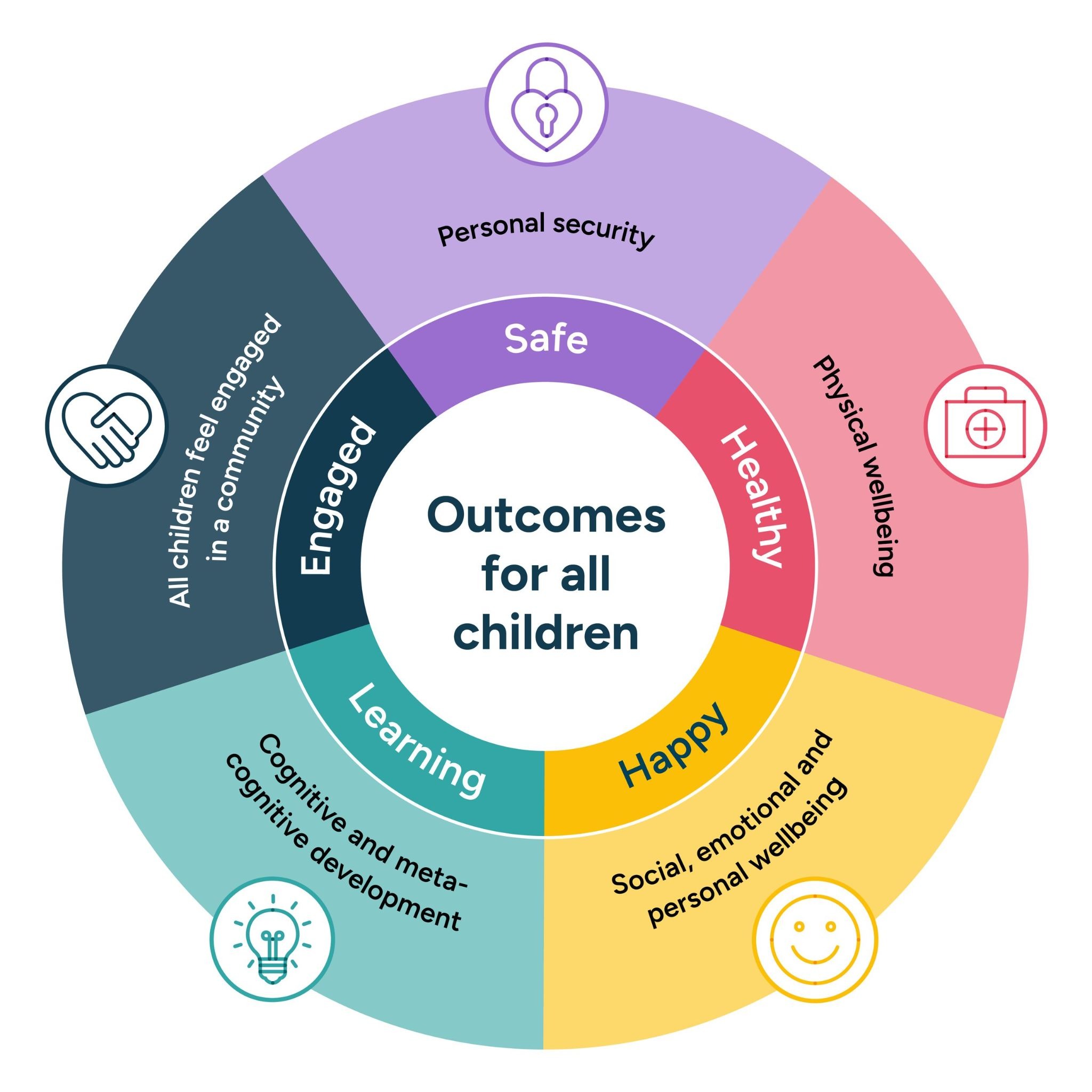
We started by defining what we mean by ‘early childhood outcomes’ – i.e. what are we talking about when we say we want to support early childhood? We use the framework developed by the Common Outcomes for Children and Young People Collaborative. We like this framework because it captures so clearly the things that evidence shows matters for children – being safe, healthy, engaged, learning and, of course, happy! It also shows these outcomes are interlinked. For example, it’s hard to learn effectively when you are not healthy or safe. We also appreciate the way it has been developed – through years of widescale conversation, testing and iteration with people across sectors working to support childhood. We think system complexity poses the same risk across organisations as it does within – speaking and operating at cross-purposes acting as a barrier to joining forces for combined, and larger, impact. We are continuing to support the work of the Collaborative to enable a common and more collaborative approach for children and young people.
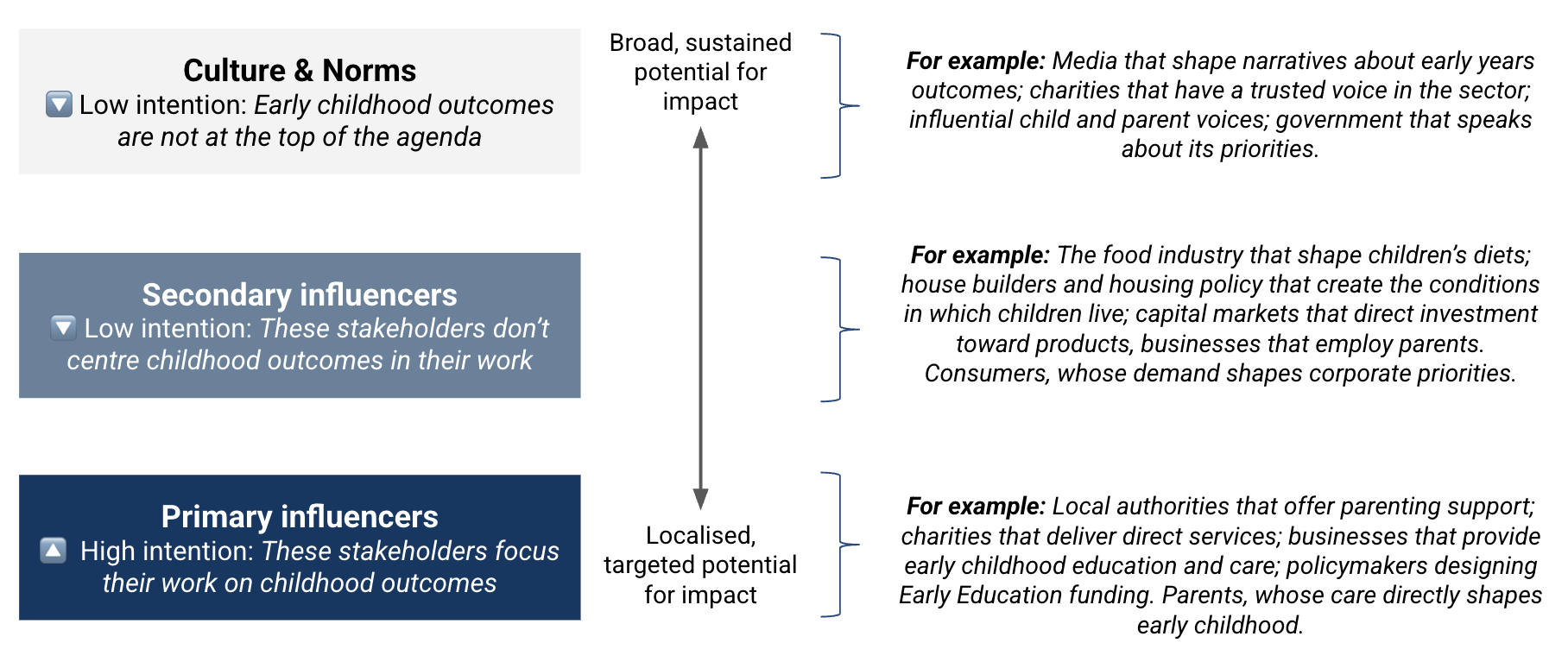
We then considered the forces that impact these outcomes and depicted them as three layers of the ‘system’. In each one, private, public, civil society and citizen stakeholders play a role (and bring a unique power), but that role looks different at each level. We want to recognise the counterintuitive fact that some of the most influential forces shaping early childhood, often inequitably (for example housing), don’t have an early childhood mission or label.
Finally, we wanted to depict how we think these levels interlink. It was our colleagues at Systems Shift – a network supporting collaboration between foundations with systems change strategies – who sketched out a visual that brought together our thinking and helped us to articulate our problem definition.
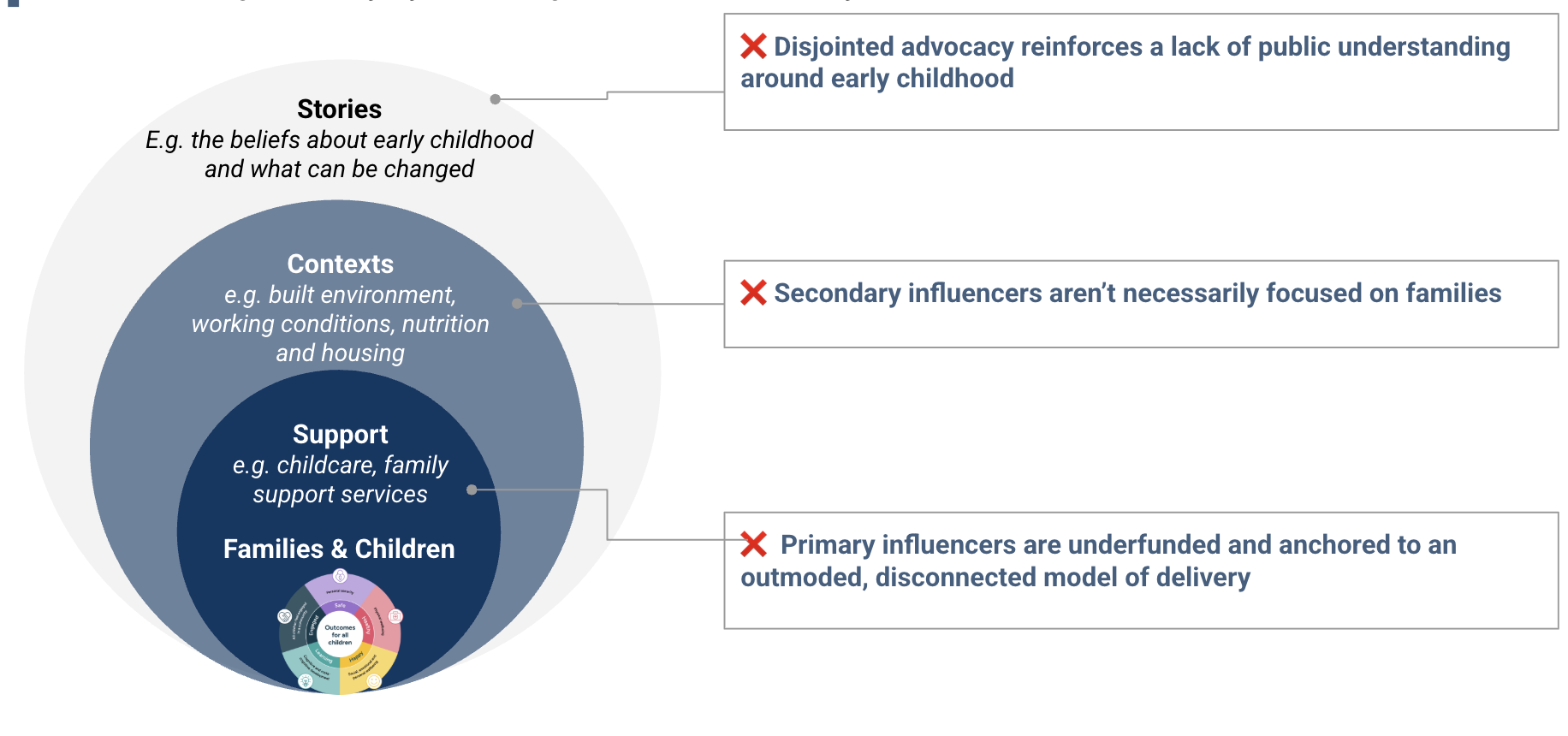
This forms the basis of our strategy. We think the evidence is clear on how much early childhood matters. We also believe there are so many assets – money, institutional resources, people, knowledge – that have power to shape early childhood, whose efforts are currently fragmented or without intention. We focus on supporting scale up of implementation models that bring together diverse assets around a shared early childhood agenda, for transformative impact. Our partnership portfolio construction, objective and budget setting, learning, sharing and influencing activity are all built around this framework.
We know this view of the system is imperfect (each year we will share what we got wrong!). We know that it is oversimplistic. However, it gives us focus and consistency internally. It gives us a view of where power lies in the system and therefore whose actions we need to understand and influence. It is also specific enough to convey to diverse audiences our assumptions as an organisation and thus allows those assumptions to be tested and evolved. For example, we very quickly changed confusing terms like ‘primary and secondary influencers’ to Support, Contexts and Stories. Our aim is to go out with a belief about early childhood systems that is ‘a strong view, loosely held, widely tested’, to support our collaboration and cumulative impact over the next ten years.
Sarah, April 2026


